
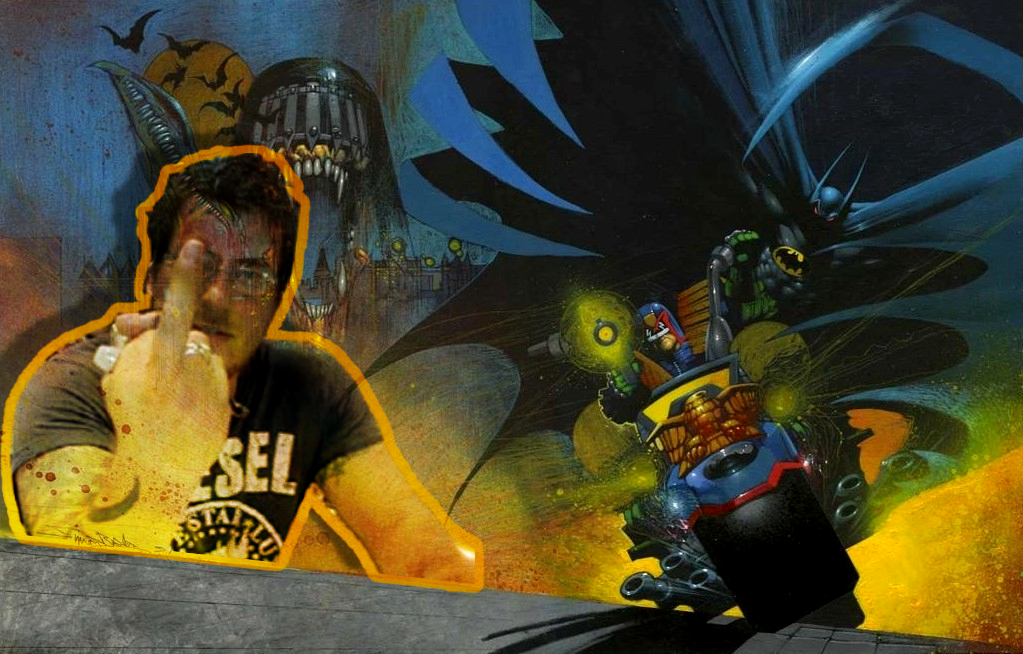
When Bisley, under pressure, delivers an unforgettable masterpiece.
In 1990, an ambitious Anglo-American comics project was born, uniting two icons: Batman and Judge Dredd. With this epic clash, the image of the “old-fashioned Batman” takes a monumental artistic blow.
“Batman/Judge Dredd: Judgment on Gotham“ is a landmark in the history of comic book crossovers. Published in 1991, it represents the explosive collision of two vastly different worlds: the dark, tortured universe of Batman and the dystopian, brutal reality of Judge Dredd.
Negotiations between DC Comics and 2000 AD were surprisingly straightforward, with both publishers simply requiring that their characters be equally represented.
Once again, following his work on Sláine, Simon Bisley brings his unique and flamboyant style to this project, blending grotesque details, vibrant colors, and theatrical compositions. Every page and every panel crafted by Bisley feels like a fine art masterpiece. His work transcends the typical standards of comics, an extraordinary anomaly often imitated but never equaled.
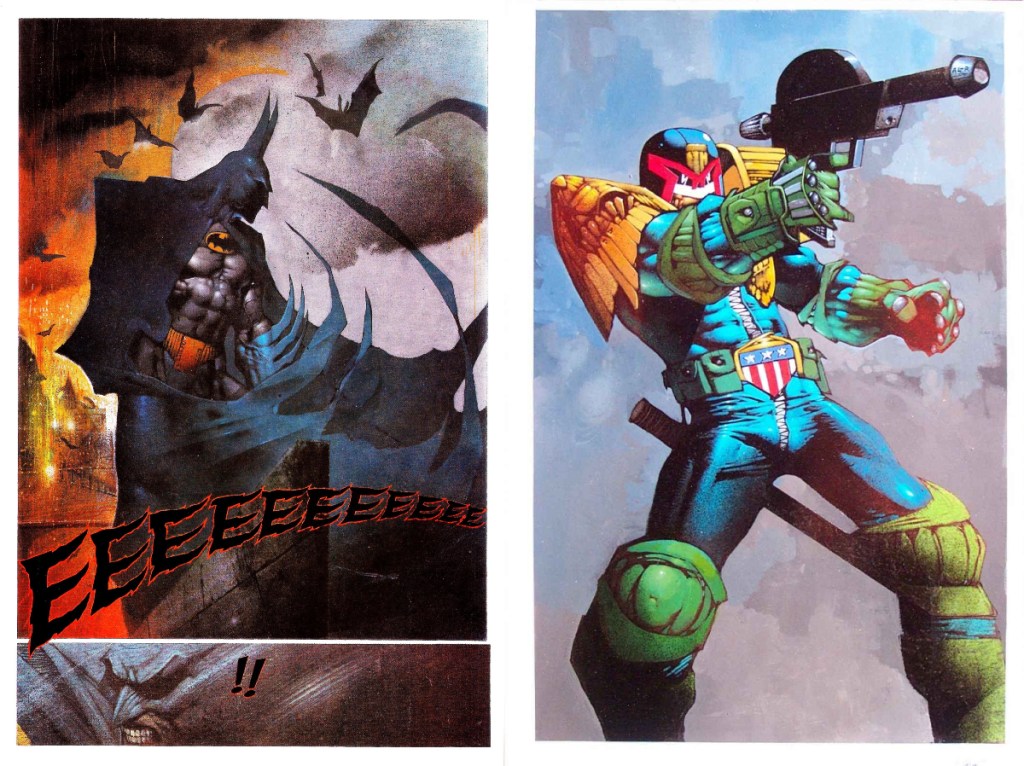
Bisley’s ability to transform every frame into an immersive work of art has cemented this comic’s reputation as a visual and narrative benchmark.
Yet, Bisley himself does not believe in the character of Batman. Neither his origin story nor his psychological development resonates with him. As for Dredd, he represents an authoritarian fascism that Bisley, a lover of freedom, finds difficult to relate to.
The artist also faced a major challenge: the unforgiving deadlines of the comic book industry. In a sector reliant on rigid printing schedules, delays were not an option. Bisley, a spontaneous and instinctive genius, had to work relentlessly—a word he particularly dislikes—to deliver his paintings on time.
So, what fueled Bisley’s creative energy? Which characters in this story did he truly understand or find fascinating?
Simon admits his affection for Mean Machine, a savage brute, an anarchist, and a battered figure. Bisley’s exuberant style enhances Mean Machine, emphasizing his wild and unbalanced nature. Under Bisley’s brush, he becomes a concentrated force of raw energy and chaos, perfectly embodying the anarchic spirit that fascinates the artist. His mechanical arm and dial on his forehead are particularly detailed, reinforcing his status as a cult figure.
Mean Machine is a tragic character—a monster created by his own father, adding a layer of pity to his often violent nature. Despite his brutality, there’s an almost childlike and unpredictable side to him that makes him strangely endearing. His obsession with destruction often borders on comedic, especially in situations where he “overdials” and causes more damage than intended.
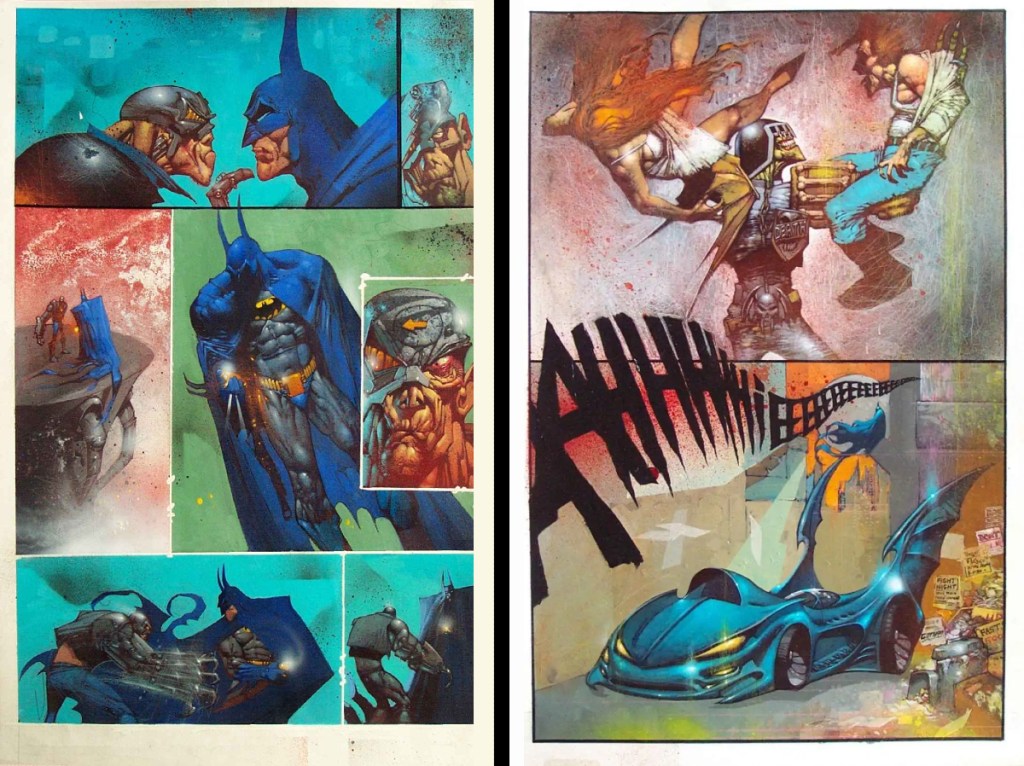
As for Judge Death, he profoundly fascinates Bisley. To him, Death represents the ultimate mystery: the concept of mortality itself. It is evident that illustrating such characters was a source of great enjoyment for the artist.
In this crossover, Judge Death teams up with other chaotic figures, making him even more dangerous. Simon Bisley fully explores Death’s visual and conceptual potential, emphasizing his grotesque and spectral nature. The hostility between Death and Batman is palpable, as Batman embodies everything Death despises: a symbol of resilience, justice, and life itself.
The contrast between their philosophies is captivating: Batman fights to protect life at all costs, while Judge Death seeks to eradicate every trace of it, considering existence itself an abomination.
The release of Batman/Judge Dredd: Judgment on Gotham was a landmark event not only for its artistic achievement but also for its groundbreaking promotional efforts. The launch signing at the Virgin Megastore in Oxford Circus, London, attracted an unprecedented crowd, with lines wrapping around the block to meet Simon Bisley, John Wagner, and Alan Grant. Even the police were stunned by the turnout, and the store manager remarked that it had drawn a bigger crowd than David Bowie’s signing event just a month prior.
The graphic novel’s success was further cemented by its critical acclaim, winning the 1992 UK Comic Art Award for Best Original Graphic Novel. Simon Bisley also earned the prestigious Eisner Award for Best Artist, along with the UK Comic Art Award for 1992. While Judgment on Gotham was nominated for the 1992 Eisner Award for Best Graphic Album: New, it ultimately lost to Will Eisner’s To the Heart of the Storm.
This book remains, to this day, a powerful source of inspiration for many artists. One can only lament that the planned follow-up—a Batman story penned by Neil Gaiman—never materialized. What wouldn’t we give to have such a masterpiece on our shelves?
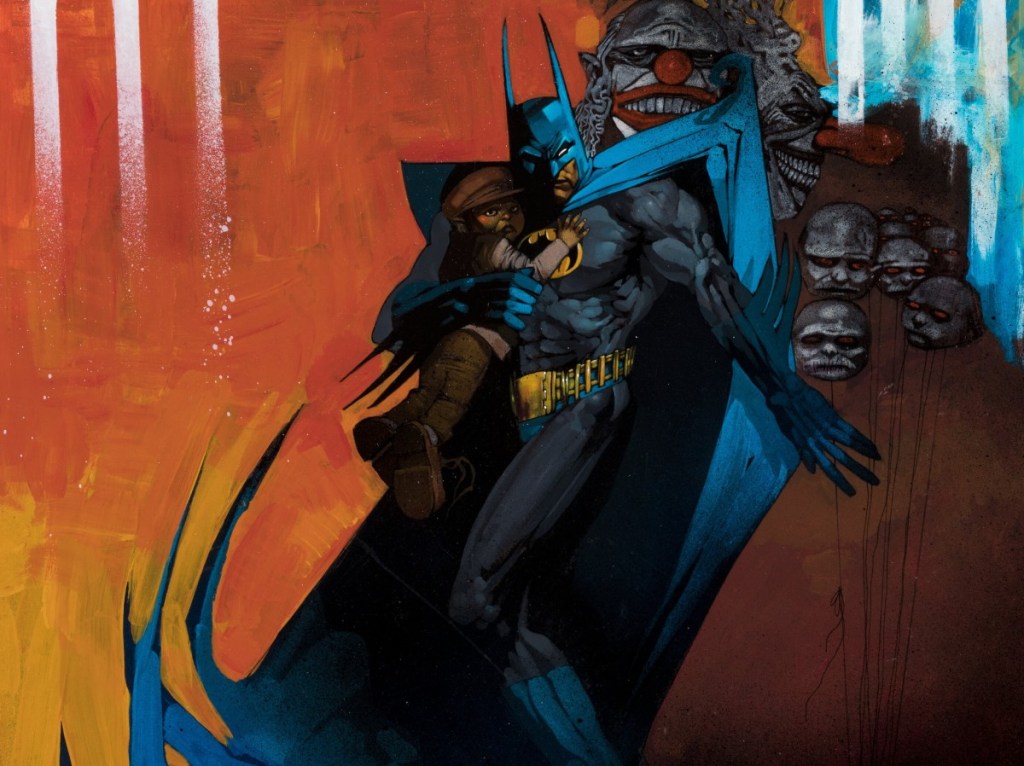
 Simon Bisley Fanboys